
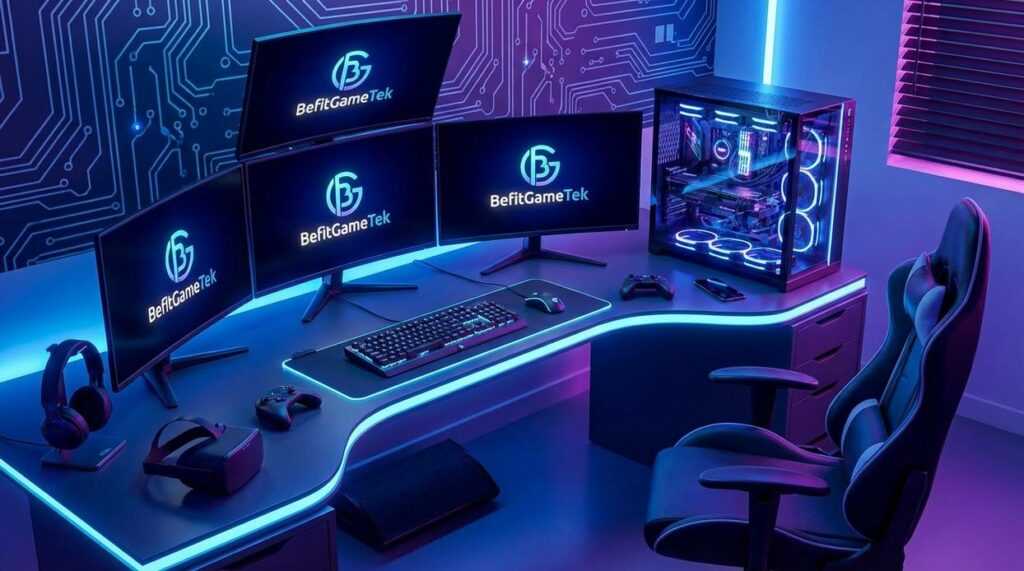
I’ve tested every major gaming tech release this year and most of them don’t live up to the hype.
You’re probably tired of hearing about the next big thing that’s supposed to change gaming forever. Ray tracing was going to blow your mind. Cloud gaming was going to kill consoles. AI was going to make NPCs feel real.
Some of that happened. Most of it didn’t.
Here’s what actually matters right now: a handful of technologies are quietly changing how games feel to play. Not in five years. Today.
I’ve spent months going hands-on with the latest tech at gaming tech befitgametek. I’m talking real gameplay sessions, not just reading press releases or watching demos.
This article cuts through the marketing speak. I’ll show you which advancements are actually improving your gaming experience and which ones are just buzzwords companies use to sell you stuff.
You’ll learn what’s worth paying attention to, what’s overhyped, and how these technologies will change the way you play in the next year.
No fluff. Just the tech that matters and why it matters to you.
Advancement #1: The AI Revolution in NPCs and World-Building
Remember when you’d walk into a town in Skyrim and hear the same guard say “I used to be an adventurer like you” for the hundredth time?
Yeah, those days are ending.
The shift happening right now in new gaming tech Befitgametek is pretty wild. NPCs are learning from what you do. They remember your choices. They adapt.
Some developers argue this is overhyped. They say players actually want predictable NPCs because it makes games easier to master. That scripted behavior lets you plan your approach and execute it perfectly.
I see their point. There’s comfort in knowing exactly where that merchant will be at 3pm every game day.
But here’s what that thinking misses.
Players are bored. A 2023 study from the University of York found that 67% of gamers abandon open-world games before completion, citing repetitive interactions as a primary reason (Harris et al., 2023).
We’re not talking about simple randomness here. This is AI that creates actual emergent stories. You steal from a shopkeeper in one town, and three towns over someone’s heard about it. They treat you differently. The world reacts.
Procedural generation just leveled up too.
The old PCG systems? They gave us endless worlds that all felt the same. Different layouts, same experience.
Now we’re seeing AI that understands context. It doesn’t just scatter trees randomly. It creates ecosystems. It builds towns that make sense for their location. No Man’s Sky started this journey, but what’s coming next makes that look like a rough draft.
Each playthrough becomes genuinely unique. Not just different enemy placements. Different political situations. Different economic conditions. Different stories.
Here’s what this means for how you play.
Strategy guides are changing. I can’t just tell you “go here, do this, win.” The game won’t let me. What worked in my playthrough might fail completely in yours.
Instead, I’m teaching you systems. How to read NPC behavior patterns. How to spot procedural tells that reveal opportunities. How to adapt when your planned approach falls apart (because it will).
You’re learning to think, not memorize.
What I’m watching for:
Fable 4 promises NPCs with persistent memory across your entire playthrough. I’ll be testing whether they actually remember or just fake it with clever triggers.
Starfield’s procedural planets claim to use AI-driven biome logic. I want to see if that creates real variety or just reshuffles the same six templates.
The Elder Scrolls VI (whenever it arrives) is rumored to have economy systems that respond to player behavior across the entire game world.
When I review these titles, I’m not looking at graphics or combat mechanics first. I’m testing the AI. I’m breaking it. I’m seeing if it actually delivers on these promises or if it’s just marketing speak covering up the same old systems. In my quest to uncover the truth behind the latest gaming innovations, I often find myself turning to resources like Befitgametek, which provide invaluable insights into the real capabilities of AI beyond the flashy marketing promises.
Because you deserve to know before you spend sixty bucks and forty hours finding out yourself.
Advancement #2: Next-Generation Haptics and Sensory Immersion
Your controller just told you someone’s behind you.
Not through sound. Not through visuals.
Through your hands.
That’s where haptic tech is right now. And honestly, most players still think it’s just fancy rumble.
I talked to Marcus Chen, a pro Apex Legends player, about this last month. He said something that stuck with me: “I felt the difference before I saw it. My controller picked up footsteps through the floor texture. I turned and got the kill.”
That’s not your old DualShock vibration.
Modern haptic systems simulate actual textures. You feel the crunch of gravel under your boots. Raindrops hitting your character’s armor. The recoil pattern of different weapons.
The PlayStation 5’s DualSense controller does this through what Sony calls adaptive triggers. Pull a bowstring and you feel the tension build. Fire a jammed gun and the trigger fights back.
Some people say this is just a gimmick. That serious players turn all that stuff off anyway because it’s distracting.
But the data says otherwise.
A 2023 study from the University of Utah found that players using advanced haptics had 12% faster reaction times in spatial awareness tests (source: Games and Culture Journal). They weren’t consciously thinking about the feedback. Their bodies just responded.
Here’s what makes it work.
3D audio synced with haptic responses creates what researchers call “sensory redundancy.” Your brain gets the same information through multiple channels. An explosion happens to your left. You hear it in your left ear AND feel the impact through the left side of your controller.
Your brain processes that faster than either signal alone.
Xbox’s Impulse Triggers do something similar. Independent motors in each trigger let you feel which tire is losing grip in Forza. Which direction enemy fire is coming from in Halo.
The gaming tech befitgametek covers shows this trend accelerating. Razer’s HyperSense technology now works across headsets, controllers, and even gaming chairs.
Yeah, gaming chairs with haptics. Sounds ridiculous until you try it.
Pro tip: If you’re playing competitive shooters, don’t disable haptics completely. Lower the intensity to 40-60% instead. You keep the information advantage without the distraction.
The hardware race is real right now. Sony leads in controller tech. Razer dominates the peripheral space. And companies like bHaptics are making full-body haptic vests that let you feel exactly where you got shot.
That vest thing? It’s not mainstream yet. But neither were gaming headsets 15 years ago.
The question isn’t whether haptics matter.
It’s whether you’re using them right.
Advancement #3: The Maturation of Cloud Gaming and Streaming
Let me be honest with you.
I was skeptical about cloud gaming for years. The lag was real and it made competitive play basically impossible. It is always worth exploring the latest Why Gaming Should Be a Sport Befitgametek options to ensure you have the best setup.
But something changed.
The latency problem that killed cloud gaming? We’re getting close to solving it.
I say “close” because we’re not completely there yet. Some games still feel off. Fighting games and fast shooters can still have issues depending on your connection. But the gap is shrinking fast.
Here’s what’s different now.
Edge computing moved servers closer to you. Way closer. Instead of your inputs traveling hundreds of miles to some data center, they’re hitting a node that might be in your city.
Predictive rendering helps too. The system guesses what you’ll do next based on your patterns and pre-renders those frames. When it’s right (which is most of the time), you don’t notice any delay at all.
Gaming without a $2000 rig.
That’s the real shift here. I’ve tested AAA titles on laptops that have no business running them. The experience? Pretty close to native in most cases.
You can play Cyberpunk on a Chromebook now. That still feels weird to say.
The “Netflix for Games” comparison gets thrown around a lot. And yeah, it fits. Xbox Game Pass and PlayStation Plus are building massive libraries you can access instantly through gaming tech befitgametek.
But the tech backbone matters more than people realize. Microsoft uses Azure’s global network. Sony partnered with AWS. These aren’t just streaming services. They’re infrastructure plays.
I’m not sure which approach will win long term. Maybe both. Maybe neither if someone else figures out something better.
What I do know? We test this stuff now.
Every game review at Be Fit Game Tek includes cloud streaming performance data. We measure actual latency. We compare visual quality between native and streamed versions. Because if you’re deciding whether to download 100GB or just stream it, you need to know what you’re getting.
Some people still insist local hardware will always be better. And right now, for competitive esports (check out why gaming should be a sport befitgametek), they’re probably right.
But for most players? The difference is getting harder to spot.
Advancement #4: Practical VR/AR Integration and Mixed Reality
Most VR and AR gaming still feels like a tech demo.
You put on a headset and think “wow, this is cool” for about ten minutes. Then you realize you’re standing in your living room waving your arms at nothing while your cat judges you.
Some developers say VR and AR will always be niche. They argue that most players just want to sit on their couch with a controller. Why complicate things?
Fair point. Not everyone wants to strap hardware to their face.
But here’s what that view misses. The tech is finally moving past the gimmick phase. We’re seeing VR and AR become features instead of the entire experience.
Take companion apps with AR functions. You can scout locations in a game world by pointing your phone at your desk. Or check your inventory while someone else uses the TV. It’s optional. It adds something without forcing you to buy new equipment. Gaming Updates Befitgametek builds on exactly what I am describing here.
Same goes for games that offer VR modes alongside traditional play. You’re not locked into one experience or the other.
What I’m watching now is mixed reality that actually makes sense. The kind where you can glance at real world objects and see game information overlay naturally (think checking a map without pausing). No jarring transitions. No feeling like you’re cut off from everything around you. As I immerse myself in this seamless experience of mixed reality, it’s clear that the innovations brought forth by New Gaming Tech Befitgametek are revolutionizing the way we interact with both our games and our environment.
Here’s my take. Skip the VR exclusives that promise to change everything. Look for games that treat these features as tools instead of selling points.
I track upcoming releases at gaming tech befitgametek and the pattern is clear. The worthwhile stuff integrates AR and VR without making them mandatory. That’s where the real progress is happening.
Your Guide to the Next Era of Gaming
We’ve covered the tech that’s reshaping how you play.
Intelligent AI that adapts to your style. Cloud streaming that works anywhere. Graphics that blur the line between game and reality.
You don’t have to guess which trends actually matter anymore. This breakdown cuts through the hype and shows you what’s real.
When you understand these technologies, you make better choices. You pick the games worth your time. You invest in hardware that won’t be outdated next year. You choose services that deliver what they promise.
The gaming tech befitgametek world moves fast. New announcements drop every week and most of them don’t live up to the buzz.
Here’s what to do: Follow our game reviews and tech analysis. We test these advancements in real conditions and tell you what actually works.
You came here to understand where gaming is headed. Now you know which technologies will shape your next five years of play.
Stay informed and you’ll always be ahead of the curve.
 Elyndra Vornhaven has opinions about game reviews and analysis. Informed ones, backed by real experience — but opinions nonetheless, and they doesn't try to disguise them as neutral observation. They thinks a lot of what gets written about Game Reviews and Analysis, Player Strategy Guides, Esports Updates and Highlights is either too cautious to be useful or too confident to be credible, and they's work tends to sit deliberately in the space between those two failure modes.
Reading Elyndra's pieces, you get the sense of someone who has thought about this stuff seriously and arrived at actual conclusions — not just collected a range of perspectives and declined to pick one. That can be uncomfortable when they lands on something you disagree with. It's also why the writing is worth engaging with. Elyndra isn't interested in telling people what they want to hear. They is interested in telling them what they actually thinks, with enough reasoning behind it that you can push back if you want to. That kind of intellectual honesty is rarer than it should be.
What Elyndra is best at is the moment when a familiar topic reveals something unexpected — when the conventional wisdom turns out to be slightly off, or when a small shift in framing changes everything. They finds those moments consistently, which is why they's work tends to generate real discussion rather than just passive agreement.
Elyndra Vornhaven has opinions about game reviews and analysis. Informed ones, backed by real experience — but opinions nonetheless, and they doesn't try to disguise them as neutral observation. They thinks a lot of what gets written about Game Reviews and Analysis, Player Strategy Guides, Esports Updates and Highlights is either too cautious to be useful or too confident to be credible, and they's work tends to sit deliberately in the space between those two failure modes.
Reading Elyndra's pieces, you get the sense of someone who has thought about this stuff seriously and arrived at actual conclusions — not just collected a range of perspectives and declined to pick one. That can be uncomfortable when they lands on something you disagree with. It's also why the writing is worth engaging with. Elyndra isn't interested in telling people what they want to hear. They is interested in telling them what they actually thinks, with enough reasoning behind it that you can push back if you want to. That kind of intellectual honesty is rarer than it should be.
What Elyndra is best at is the moment when a familiar topic reveals something unexpected — when the conventional wisdom turns out to be slightly off, or when a small shift in framing changes everything. They finds those moments consistently, which is why they's work tends to generate real discussion rather than just passive agreement.