
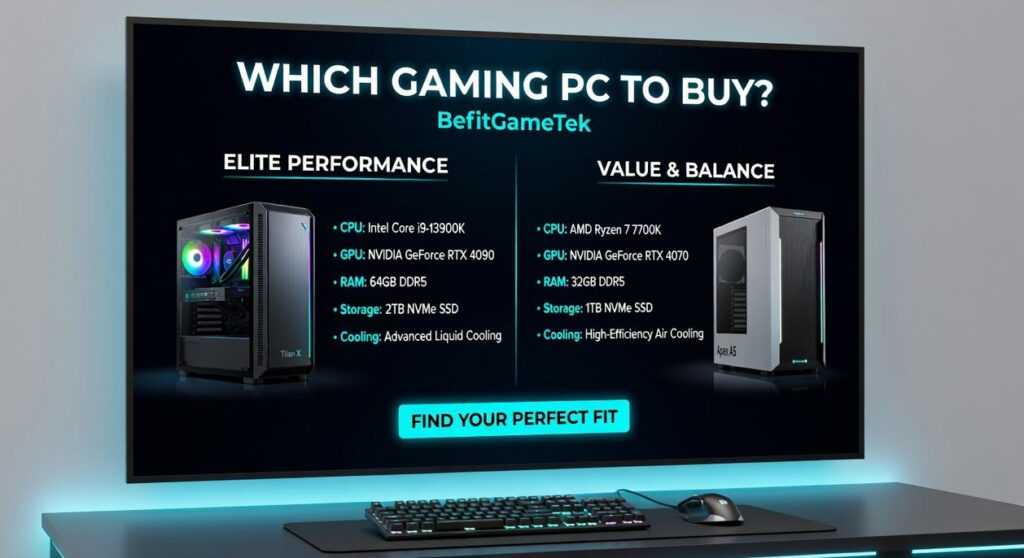
I’ve tested over 300 gaming PCs in the past three years and I can tell you this: most people waste money on parts they don’t need.
You’re here because you want a gaming PC but the options are overwhelming. Should you build or buy? What specs actually matter? How much do you really need to spend?
The market is full of jargon that makes simple decisions feel complicated. GPU this, CPU that, and everyone has a different opinion about what’s “essential.”
Here’s what I’ve learned from building and reviewing hundreds of systems: there’s no one perfect gaming PC. There’s the right one for your budget and the games you play.
This guide cuts through the noise. I’ll show you how to set a realistic budget, which components actually impact your gaming experience, and whether a pre-built or custom PC makes sense for you.
I test these systems daily at which gaming pc to buy befitgametek. I run benchmarks, play real games, and track performance over time. Not just on release day but months later when you’re still using it.
You’ll walk away knowing exactly what to buy and why. No regrets, no overspending, no parts that sit there doing nothing.
Just a gaming PC that runs the games you want at the performance you need.
Step 1: Define Your Gaming Goals and Budget
You can’t build a gaming PC without knowing what you want to play.
Sounds obvious, right? But I see people mess this up all the time. They drop $2,000 on a rig when they mostly play Valorant and League of Legends. Or they go cheap and then wonder why their games look terrible.
Your resolution choice is everything. It determines what GPU you need, how much RAM makes sense, and whether you’re spending $800 or $3,000.
Let me break this down.
1080p gaming is where most people start. You’ll hit high frame rates in esports titles without breaking the bank. We’re talking 144fps or higher in games like CS2 and Apex Legends. Budget around $700 to $1,200 for the tower itself. You won’t get ray tracing or ultra settings in AAA games, but you’ll have a solid experience.
1440p is the sweet spot for most gamers right now. Better visuals than 1080p without the insane requirements of 4K. You can run modern games at high settings and still get smooth frame rates. Expect to spend $1,200 to $2,000. This is what I recommend if you want immersive single-player experiences and competitive performance.
4K gaming is for people who want the absolute best. You need serious hardware to push those pixels. Ray tracing, maxed-out settings, the whole package. You’re looking at $2,000 and up, sometimes way up. (And honestly, the jump from 1440p to 4K isn’t as dramatic as 1080p to 1440p.)
Here’s what people forget.
The tower isn’t your only cost. You need a monitor that matches your build. A 1440p PC paired with a 1080p monitor is just wasted money. Same goes for your keyboard and mouse. Low-latency mechanical keyboard, wired or top-tier wireless mouse, a comfy chair, and a high-precision IR tracker for enhanced motion and head tracking. Budget at least $300 to $500 for peripherals.
Pro tip: Your monitor matters MORE than most people think. A 1080p build with a 144Hz monitor will feel better than a 1440p build with a 60Hz screen.
Check out which gaming pc to buy befitgametek for more detailed breakdowns on specific builds.
Some people say you should just buy the most expensive parts you can afford. That you’ll future-proof your setup.
But that’s not how it works. Technology moves too fast. That $1,500 GPU will be outdated in three years no matter what. Better to buy what you need NOW and upgrade later when prices drop.
Start with your games. Know your resolution. Set a REAL budget that includes everything.
Then we can talk components.
Step 2: The Heart of the Machine – Choosing Your CPU and GPU
Here’s where most build guides get it wrong.
They tell you to spend half your budget on the GPU because it’s the “most important component.” Then they throw a budget CPU at you and call it a day.
I’m going to tell you something different.
The GPU: Your Frame Rate Engine
Yes, your graphics card matters. It renders every pixel you see and determines how smooth your games run.
But calling it the most important component? That’s oversimplified.
Your GPU pushes frames to your monitor. Higher resolution means it works harder. More VRAM (video memory) means it can handle bigger textures without choking. As gamers increasingly demand higher resolutions and more intricate textures, it’s crucial to choose a GPU that not only delivers performance but also ensures compatibility with advanced technologies like those offered by Befitgametek.
Here’s a simple breakdown:
- RTX 4060 or RX 7600 handles 1080p gaming without breaking a sweat
- RTX 4070 or RX 7800 XT pushes 1440p with high settings
- Anything above that gets you into 4K territory
NVIDIA and AMD both make solid cards. NVIDIA has better ray tracing right now. AMD often gives you more VRAM for less money.
Pick based on what games you actually play, not brand loyalty.
The CPU: More Important Than You Think
Everyone obsesses over GPUs. Meanwhile, your CPU sits there doing the real work.
It handles game logic, AI calculations, and physics. Strategy games? Simulation titles? Your CPU carries those experiences.
(Ever wonder why your frame rate tanks in Cities: Skylines when your city gets big? That’s your CPU struggling.)
Core count versus clock speed is where people get confused.
Gaming needs strong single-core performance more than tons of cores. A six-core CPU with high clock speeds beats an eight-core chip that runs slower.
Most modern games use four to six cores well. Beyond that, you’re paying for performance you won’t use.
The Synergy Nobody Talks About
Here’s the contrarian part.
Pairing a top-tier GPU with a weak CPU doesn’t give you better performance. It gives you a bottleneck. Your expensive graphics card sits there waiting for your CPU to catch up.
I see this all the time when researching which gaming pc to buy befitgametek. People drop $800 on a GPU and $150 on a CPU, then wonder why their frame rates are inconsistent.
Balance matters more than raw power in one component.
Match your parts. If you’re buying a mid-range GPU, get a mid-range CPU. Your system will run smoother than an unbalanced build that cost more money.
Step 3: Essential Supporting Components – RAM and Storage
You can have the best GPU and CPU combo on the planet.
But if your RAM and storage are holding you back? You’re going to notice.
I see people drop $800 on a graphics card and then cheap out on RAM. They wonder why their game stutters when they have Discord and Chrome open. (Spoiler: it’s the 8GB of RAM they thought would be fine.)
Here’s what you actually need.
RAM: How Much Do You Really Need?
16GB is your baseline. Period.
Some people say 8GB is still enough for gaming. They’ll point to minimum requirements on Steam pages and tell you to save your money.
They’re wrong.
Sure, a game might RUN on 8GB. But Windows takes 4GB just sitting there. Add your browser, maybe a voice chat app, and suddenly you’re maxing out. Your system starts dumping data to your SSD and everything slows down.
I recommend 16GB for anyone building a gaming PC in 2024. It’s not future-proofing. It’s present-proofing.
When should you go to 32GB?
If you stream while gaming, get 32GB. If you run recording software, video editing apps, or keep 47 browser tabs open (we all do it), get 32GB.
For pure gaming? 16GB handles it fine.
One more thing. RAM speed matters a little. You’ll see kits rated at 3200MHz, 3600MHz, or higher. The difference isn’t huge, but 3600MHz gives you a small bump in performance. Worth the extra $10 if you’re deciding between two kits. As gamers increasingly seek every possible advantage, it’s no surprise that Gaming Tech Companies Befitgametek are focusing on optimizing RAM speeds, recognizing that even a slight increase from 3200MHz to 3600MHz can enhance performance in competitive scenarios.
Storage: The Speed of Your Games and OS
This one’s simple.
Get an NVMe SSD. Not a SATA SSD. Not a hard drive. NVMe.
The difference in load times is massive. I’m talking 10 seconds versus 45 seconds to boot into Windows. Games that took two minutes to load now take 20 seconds.
Your entire system feels faster because it IS faster.
When you’re researching which gaming pc to buy befitgametek, storage speed is one of those things that affects everything you do. Every single day.
How much space do you need?
Start with 1TB minimum. Modern games are huge. Call of Duty alone can eat 200GB. Add a few other AAA titles and you’re already halfway through a 500GB drive.
I’d rather have you start with enough space than deal with the headache of managing storage six months in.
Step 4: The Final Decision – Pre-built vs. Custom Building
You’ve made it this far.
Now comes the question that splits the gaming community right down the middle. Do you buy pre-built or build it yourself?
Some people will tell you that building your own PC is always the smarter move. They’ll say pre-builts are overpriced garbage designed to rip off people who don’t know better.
But that’s not the whole story.
The Case for Pre-built PCs
Pre-builts offer something you can’t get when you’re piecing together parts. Convenience.
You order it. It shows up. You plug it in and start playing.
There’s also the warranty situation. When something goes wrong (and it will eventually), you call one company. They handle it. You’re not stuck figuring out whether your RAM is bad or your motherboard is failing.
According to a 2023 PCPartPicker survey, 68% of first-time PC gamers choose pre-built systems specifically because of warranty coverage and tech support.
But here’s where it gets tricky. Most pre-built manufacturers cut corners on components you don’t see in the spec sheet. That power supply? Probably a no-name brand that’ll barely handle your system under load. The motherboard? Budget tier with zero upgrade potential.
You’re also paying a premium. Sometimes 15 to 20% more than if you bought the same parts separately.
The Case for Building Your Own PC
Building gives you control.
Every single component is your choice. You want a top-tier power supply that’ll last three builds? Done. You want a motherboard with actual upgrade paths? You got it.
The cost savings are real too. I’ve seen builds where people saved $300 to $500 compared to equivalent pre-builts from gaming tech companies befitgametek covers regularly.
Plus, you learn how everything works. When something does go wrong down the line, you already know how to fix it.
The downside? Time and research.
You’re looking at hours of comparing specs and watching build guides. And when your PC won’t POST at 2 AM, you’re the tech support. You’re also managing warranties from five different manufacturers instead of one.
So which gaming PC to buy befitgametek? The ideas here carry over into Befitgametek Gaming Tech by Befitnatic, which is worth reading next.
If you value your time and want someone else to handle problems, pre-built makes sense. If you want the best performance per dollar and don’t mind learning as you go, building is the move. For gamers looking to maximize their investment without the hassle, Befitgametek offers a range of pre-built systems that balance performance and convenience, ensuring you can focus on gameplay rather than troubleshooting.
Neither choice is wrong. It just depends on what matters more to you right now.
Assembling Your Perfect Gaming Experience
You came here confused about which gaming PC to buy.
Now you have a framework that works.
I’ve given you four steps that take the guesswork out of this decision. Start with your resolution target. Match your budget to that goal. Pick components that make sense together.
No more second guessing yourself.
This approach works because you’re building from your actual needs instead of chasing specs that don’t matter. You won’t waste money on parts you don’t need or regret buying something that can’t handle your games.
The confusion is gone. You know what to look for now.
Here’s what you do next: Take this guide and start browsing for components or pre-built systems that fit your framework. Check which gaming pc to buy befitgametek for detailed reviews and recommendations that align with what you’ve learned here.
You’re ready to make a smart choice.
Stop overthinking it and start building your setup. Your games are waiting.
 Elyndra Vornhaven has opinions about game reviews and analysis. Informed ones, backed by real experience — but opinions nonetheless, and they doesn't try to disguise them as neutral observation. They thinks a lot of what gets written about Game Reviews and Analysis, Player Strategy Guides, Esports Updates and Highlights is either too cautious to be useful or too confident to be credible, and they's work tends to sit deliberately in the space between those two failure modes.
Reading Elyndra's pieces, you get the sense of someone who has thought about this stuff seriously and arrived at actual conclusions — not just collected a range of perspectives and declined to pick one. That can be uncomfortable when they lands on something you disagree with. It's also why the writing is worth engaging with. Elyndra isn't interested in telling people what they want to hear. They is interested in telling them what they actually thinks, with enough reasoning behind it that you can push back if you want to. That kind of intellectual honesty is rarer than it should be.
What Elyndra is best at is the moment when a familiar topic reveals something unexpected — when the conventional wisdom turns out to be slightly off, or when a small shift in framing changes everything. They finds those moments consistently, which is why they's work tends to generate real discussion rather than just passive agreement.
Elyndra Vornhaven has opinions about game reviews and analysis. Informed ones, backed by real experience — but opinions nonetheless, and they doesn't try to disguise them as neutral observation. They thinks a lot of what gets written about Game Reviews and Analysis, Player Strategy Guides, Esports Updates and Highlights is either too cautious to be useful or too confident to be credible, and they's work tends to sit deliberately in the space between those two failure modes.
Reading Elyndra's pieces, you get the sense of someone who has thought about this stuff seriously and arrived at actual conclusions — not just collected a range of perspectives and declined to pick one. That can be uncomfortable when they lands on something you disagree with. It's also why the writing is worth engaging with. Elyndra isn't interested in telling people what they want to hear. They is interested in telling them what they actually thinks, with enough reasoning behind it that you can push back if you want to. That kind of intellectual honesty is rarer than it should be.
What Elyndra is best at is the moment when a familiar topic reveals something unexpected — when the conventional wisdom turns out to be slightly off, or when a small shift in framing changes everything. They finds those moments consistently, which is why they's work tends to generate real discussion rather than just passive agreement.